
Last Updated: May 2026 | Based on FEMA/NOAA/USGS data
Since January 2016, Arizona has recorded 41 federally declared disasters. Twenty-nine of them were wildfires. That single number should reframe how every Tucson household thinks about emergency planning, because this isn’t primarily a drought story or a flood story. It’s a fire-and-smoke story, with drought as the accelerant underneath everything else. The most recent declaration came in May 2026 for severe storms and flooding. Before that: the Cody Fire (May 2025), the Greer Fire (May 2025), and a string of fire declarations throughout 2024. The pattern is consistent and it points directly at what you need to do before the next one.
Your county's real disaster history, what to do first, and what to keep at home. Free, and it shows up right here.
🔒 We never sell your email. Unsubscribe in one click.
📊 AZ Federally Declared Disasters (2016–2026)
41 major disaster declarations were issued for AZ in this period, according to FEMA records.
| Disaster type | Declarations |
|---|---|
| Fire | 29 |
| Severe Storm | 5 |
| Flood | 4 |
| Biological | 3 |
Most recent declarations
| Date | Type | Event |
|---|---|---|
| 2026-05-29 | Severe Storm | Severe Storms And Flooding |
| 2025-05-22 | Fire | Cody Fire |
| 2025-05-14 | Fire | Greer Fire |
| 2024-10-25 | Flood | Flooding |
| 2024-10-04 | Fire | Watch Fire |
| 2024-07-13 | Fire | Watch Fire |
Source: FEMA OpenFEMA Disaster Declarations · retrieved 2026-07-19 by US Risk Radar.
Key Takeaways
- Arizona’s dominant federally declared disaster type is wildfire, 29 of 41 declarations since 2016.
- Drought doesn’t trigger federal declarations on its own, but it’s the condition that makes Arizona’s fires worse and its flood response more complicated.
- Tucson households need smoke and air quality plans just as much as water storage plans.
- Arizona’s monsoon season creates a secondary flash-flood risk, 4 flood declarations since 2016, often on ground hardened by drought.
- Preparation here means layering wildfire readiness, air quality response, water conservation, and post-storm flood awareness, not treating them as separate problems.
Why Wildfires Define Arizona’s Federal Disaster Profile, and What That Means in Tucson
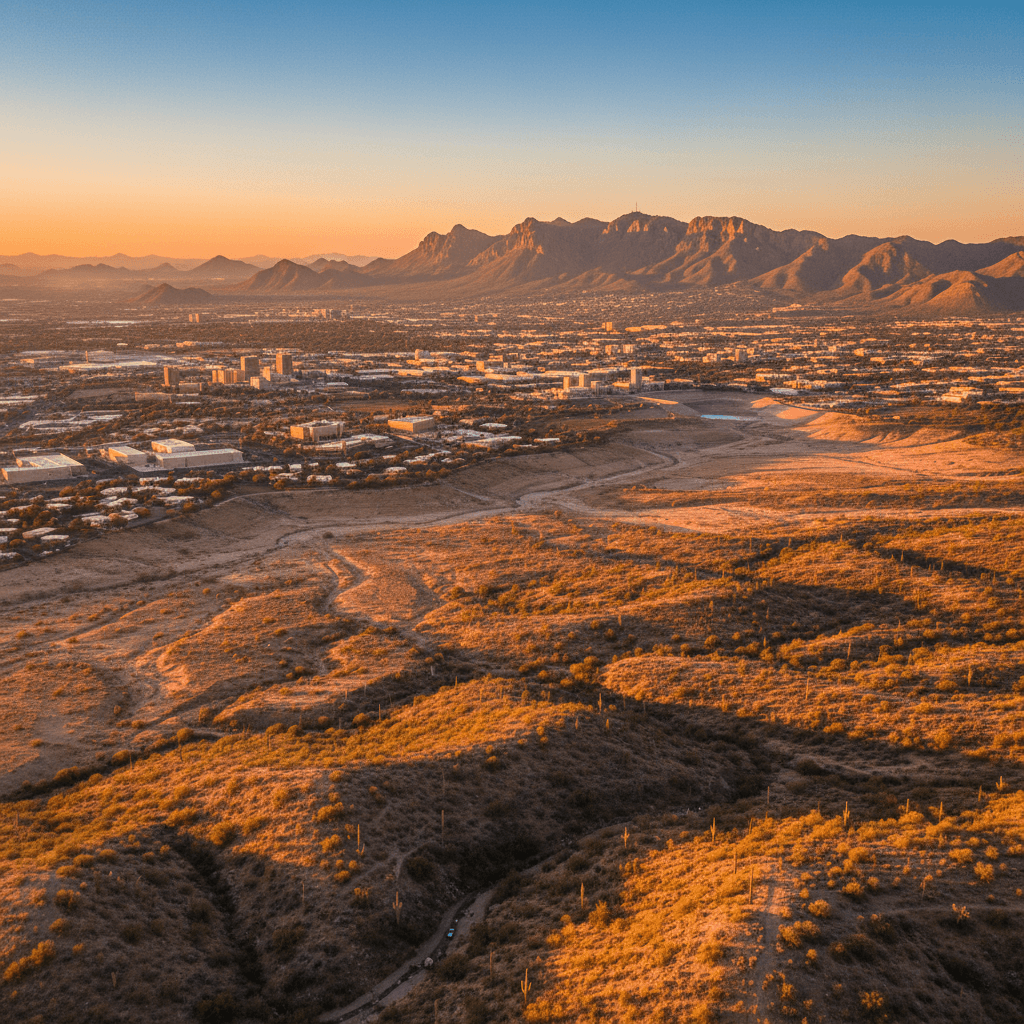
Tucson sits at roughly 2,400 feet elevation, surrounded by sky islands, the Santa Catalinas, Rincons, Tucson Mountains, where ponderosa pine and mixed chaparral meet extreme heat and persistent drought. That geography means wildfire smoke is a near-annual reality even when the fire itself is 50 miles away. The Watch Fire in June 2024, the Boulder View Fire in late June 2024, and the Shake Fire in July 2024 all generated federal declarations within weeks of each other. When fire declarations stack like that in a single summer, air quality in Pima County drops fast and stays low.
FEMA classifies wildfires as high-velocity hazards, unlike drought, you may have hours, not days, to respond. That changes your kit priorities significantly. A household preparing primarily for drought will have water covered. A household preparing for the actual dominant hazard in Arizona will also have N95 respirators, a designated shelter-in-place room with sealed gaps, and a go-bag that can be grabbed in under ten minutes.
The Drought. Fire. Flood Cycle Tucson Actually Lives In
Here’s the sequence that plays out repeatedly across southern Arizona: multi-year drought desiccates vegetation, fire burns through it in summer, then the monsoon arrives in July and August and dumps rain on bare, hydrophobic soil. That’s when flooding happens, and Arizona has four federal flood declarations since 2016 to show for it, including one as recently as October 2024.
NOAA data on Arizona’s monsoon pattern confirms that Tucson receives the majority of its annual precipitation, roughly 6 of its 12 annual inches, between July and September. When that rain hits fire-scarred or drought-hardened ground, runoff is nearly instantaneous. Arroyos that look dry in June can become moving walls of water by August afternoon. Preparing for drought without also preparing for flash flooding is an incomplete plan in this region.
Building Your Actual Preparedness Stack for Tucson
Air Quality and Smoke. Your Most Likely Activation Scenario
Given 29 fire declarations since 2016, smoke exposure is statistically your highest-probability emergency in Arizona. Every Tucson household should have:
- At least one N95 or KN95 respirator per person (surgical masks do not filter fine particulate)
- A designated interior room you can seal with painter’s tape and damp towels during active smoke events
- An air purifier with a HEPA filter rated for the square footage of your main living space
- The AirNow app or bookmark for weather.gov air quality alerts specific to Pima County
Water Storage. Still Non-Negotiable, But Size It Right
The drought reality of the Sonoran Desert means municipal water stress is a background condition, not a temporary emergency. For the full water-security checklist behind that reality, see our Drought Preparedness guide. FEMA’s baseline recommendation of one gallon per person per day is a floor, not a ceiling. In Tucson’s heat, where summer temperatures routinely exceed 105°F, hydration needs increase substantially. A realistic emergency supply for a family of four should be closer to 28 gallons for a three-day period (two gallons per person per day accounting for heat) stored in food-grade containers away from direct sunlight.
For longer-term water security, Tucson Water’s free rainwater harvesting rebate program and the Arizona Department of Water Resources both offer practical tools that go beyond emergency storage into genuine household resilience.
📦 Recommended: Water Freedom System
The Water Freedom System is an ideal solution for Tucson residents looking to secure a self-sustaining water source, providing independence from grid-based water supplies during prolonged drought conditions.
Flash Flood Readiness. The Monsoon Wildcard
If you live near a wash, an arroyo, or any low-lying area in Pima County, the October 2024 federal flood declaration is a data point worth taking seriously. Flash floods in post-fire terrain develop faster than standard flood warnings account for. Before monsoon season each year:
- Know the elevation of your property relative to nearby drainage channels
- Never attempt to drive through flooded roadways. Arizona’s Stupid Motorist Law can hold you financially liable for rescue costs
- Keep an emergency kit in your vehicle from July through September
- Sign up for Pima County Emergency Management alerts at FEMA’s recommended local channel
Emergency Kit for the Actual Hazards Here
This is calibrated for Tucson’s real risk profile, not a generic national checklist:
- Water (minimum 2 gallons per person/day for 3 days in summer heat)
- Water purification tablets or a reliable filtration straw
- N95 respirators (one per person, sealed in a zip-lock until needed)
- Portable HEPA air purifier
- Non-perishable, low-sodium food for 72 hours
- Battery-powered or hand-crank weather radio
- Flashlight, headlamp, and extra batteries
- First aid kit including burn treatment supplies
- Dust mask rated for haboob conditions (separate from wildfire N95)
- Go-bag with important documents in a waterproof sleeve, accessible in under 10 minutes
- Multi-tool and a wrench to shut off utilities
- Phone charging battery bank (keep it charged year-round)
- Cash in small bills, power outages take card readers down
Local Resources Worth Bookmarking Now
For current water restrictions and rebate programs: Tucson Water Department. For statewide water resource planning: Arizona Department of Water Resources. For real-time drought mapping: U.S. Drought Monitor. For fire weather watches and air quality: weather.gov Tucson forecast office.
Frequently Asked Questions
Arizona has had 29 wildfire federal declarations since 2016, does that affect Tucson even when fires are in northern Arizona?
Yes, significantly. Smoke from fires in the White Mountains, the Mogollon Rim, or near Flagstaff regularly drifts south into the Tucson basin. The Greer Fire in May 2025 and the Cody Fire that same month both originated far from Pima County but contributed to degraded air quality across southern Arizona. Distance doesn’t isolate Tucson from smoke events.
Why did Arizona have both fire declarations and a flood declaration in 2024?
This is the drought, fire, flood cycle in action. Severe drought dries out vegetation and soil, fire burns through it, and then monsoon rain hits ground that can no longer absorb water normally. The October 2024 federal flood declaration followed a summer of multiple fire events on precisely this pattern. It’s not a coincidence, it’s a documented sequence that repeats across Arizona.
How much water storage is actually realistic for a Tucson household to maintain long-term?
FEMA’s one-gallon-per-person-per-day baseline was designed for temperate climates. In Tucson’s summer heat, two gallons per person per day is more defensible. For a family of four over two weeks, a more realistic extended-emergency window than the standard 72 hours, that’s 112 gallons. That’s achievable with a combination of commercial water storage containers and a properly maintained rainwater harvesting system, which Tucson Water actively incentivizes through rebates.
Get real disaster prep, decoded from FEMA, NOAA & USGS.
One short email when something actually matters for your zip code. No spam, ever.