
Last Updated: May 2026 | Based on FEMA/NOAA/USGS data
North Carolina has had 23 federally declared disasters since January 2016, more than one every eight months on average. Eight of those were hurricanes, five were wildfires, four were tropical storms, and the most recent hit in January 2026 as a severe winter storm. That’s not the risk profile of a single-threat state, and a kit built only for hurricane season reflects that misunderstanding. This post is built around what FEMA’s own declaration record shows Charlotte residents actually face across twelve months of the year. Our Hurricane Preparedness guide covers the fundamentals behind that year-round risk.
Your county's real disaster history, what to do first, and what to keep at home. Free, and it shows up right here.
🔒 We never sell your email. Unsubscribe in one click.
📊 NC Federally Declared Disasters (2016–2026)
23 major disaster declarations were issued for NC in this period, according to FEMA records.
| Disaster type | Declarations |
|---|---|
| Hurricane | 8 |
| Fire | 5 |
| Tropical Storm | 4 |
| Severe Storm | 2 |
| Biological | 2 |
| Winter Storm | 1 |
| Tropical Depression | 1 |
Most recent declarations
| Date | Type | Event |
|---|---|---|
| 2026-01-24 | Winter Storm | Severe Winter Storm |
| 2025-09-11 | Tropical Depression | Tropical Depression Chantal |
| 2025-05-03 | Fire | Sunset Drive Fire |
| 2025-04-20 | Fire | Sam Davis Road Fire |
| 2025-03-27 | Fire | Table Rock Fire |
| 2025-03-26 | Fire | Alarka Fire |
Source: FEMA OpenFEMA Disaster Declarations · retrieved 2026-07-19 by US Risk Radar.
Why Hurricanes Are Only Half the Problem in Charlotte
Charlotte sits roughly 250 miles from the coast, which gives residents a false sense of distance from Atlantic storms. In reality, every hurricane on NC’s FEMA record since 2016 produced inland impacts, flooded creek corridors, downed transmission lines, and multi-day power outages across Mecklenburg County. The Catawba River watershed that runs through metro Charlotte is particularly vulnerable to surge-style flooding when tropical systems stall over the Piedmont. FEMA has designated this pattern a recurring threat, not an anomaly.
But the five wildfire declarations, including the Black Cove Fire Complex, Table Rock Fire, Alarka Fire, Sam Davis Road Fire, and Sunset Drive Fire, all occurring between March and May 2025, signal something Charlotte-area residents often overlook: western NC’s wildland-urban interface generates smoke, evacuation orders, and air quality emergencies that reach the metro. If you have family in the foothills, or commute through corridors like I-40 west of Morganton, wildfire is a legitimate planning factor.
Then there’s the January 2026 Severe Winter Storm declaration. Ice storms in the Piedmont regularly disable the power grid far longer than hurricanes, because frozen tree limbs take down lines across a wider geographic area and road conditions delay repair crews. A 72-hour kit that doesn’t account for cold-weather survival, heating, layering, frozen pipe risk, is seasonally incomplete.
Building the Kit Around Charlotte’s Actual Threat Sequence
FEMA’s baseline recommendation is one gallon of water per person per day and a three-day food supply, but the structure of your kit matters as much as the contents. Charlotte’s threat calendar looks like this: wildfire smoke risk peaks March through May, hurricane season runs June through November (Tropical Depression Chantal made landfall September 11, 2025), and winter ice events are increasingly frequent from December through February. That means your kit needs to be functional across temperature extremes and two distinct evacuation scenarios, one where you leave quickly due to flooding or fire, and one where you shelter in place during a winter outage.
Here’s what that means in practical terms:
- Water for both scenarios. During a flood evacuation, you’re mobile and need portable hydration. During a winter storm, you may need to melt snow or work around frozen pipes. Store at least three gallons per person and include a filtration method rated for field use, since Charlotte’s flooding events have historically compromised municipal water pressure in low-lying neighborhoods.
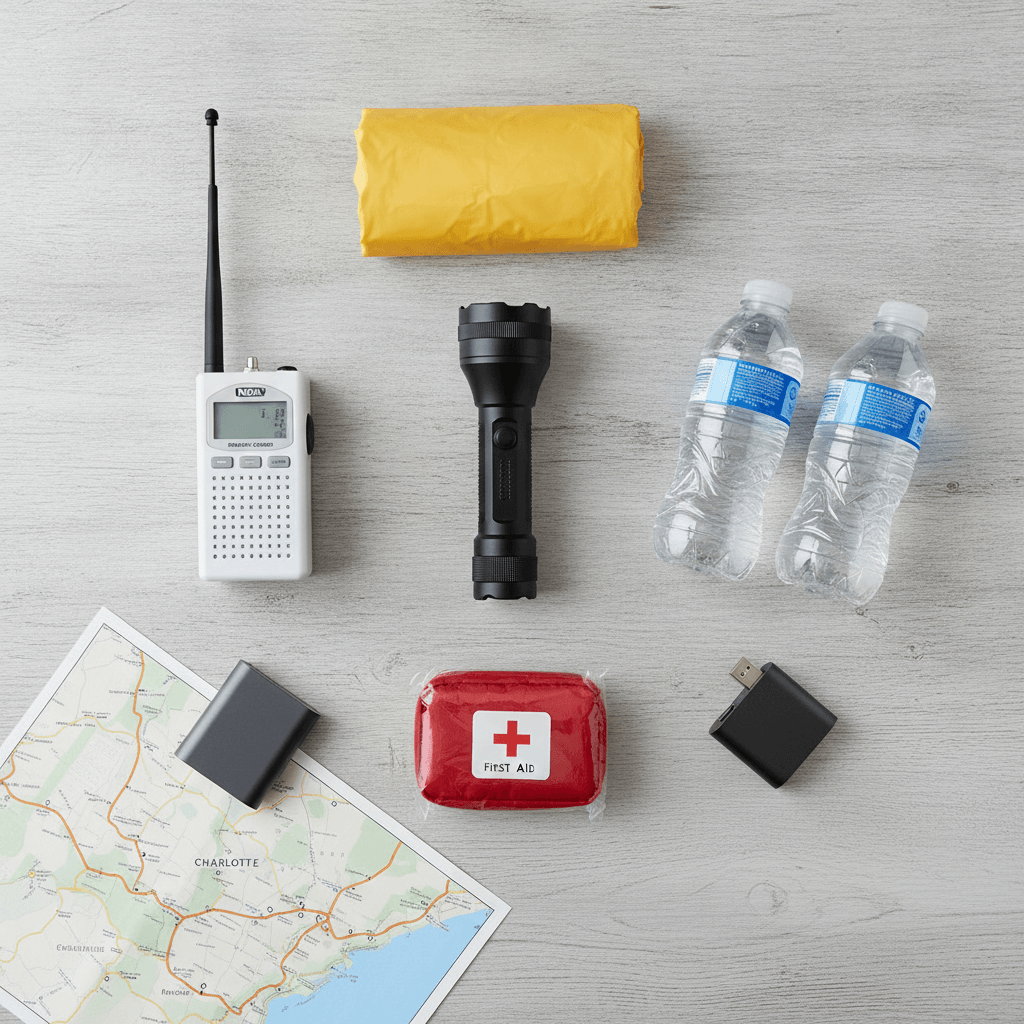
- Power redundancy that works in heat and cold. Solar chargers lose efficiency in overcast winter conditions. A hand-crank NOAA Weather Radio, which the National Weather Service at weather.gov recommends as a primary alert method, works regardless of cloud cover or grid status. Lithium batteries retain charge in cold temperatures better than alkaline; store accordingly.
- Documents sealed and ready. FEMA’s post-disaster assistance process requires proof of address, insurance policies, and identification. In both a flood evacuation and a wildfire evacuation, these are the items people regret leaving behind. Store copies in a waterproof bag inside the kit, not in a drawer somewhere else in the house.
- N95 masks alongside first-aid supplies. Five wildfire declarations in three years means smoke exposure is a documented regional hazard. Surgical masks do not filter fine particulate matter at the level that wildfire smoke requires. N95s do, and they’re compact enough to include without meaningful weight penalty.
The Strategic Layer: What to Do When the Kit Runs Out
A 72-hour kit covers the first three days. Charlotte’s past storm declarations show outages and infrastructure disruptions that extended well beyond that window, particularly after major hurricanes when utility crews are prioritized toward eastern NC coastal counties before circling back to the Piedmont. Having a structured plan for days four through fourteen is where most families are underprepared.
📦 Recommended: Alive After the Fall
This guide offers a complete disaster survival plan, covering food, water, and shelter requirements specifically for hurricane-prone regions like North Carolina.
The strategic value here isn’t mysticism, it’s inventory logic. When supply chains to Charlotte grocery stores are disrupted, as they were during several of the state’s 23 declared events, knowing your household’s actual consumption rate for food, fuel, and medicine across a longer window is what separates a stressful week from a dangerous one.
Medical Readiness When Roads Are Closed
Atrium Health’s major campuses in Charlotte have historically remained operational during storm events, but access to them is a different matter. Flooding in areas like the South End, Plaza Midwood, and along Little Sugar Creek greenway can cut off road routes even when the hospital itself is functional. Tropical systems that stall over the Piedmont, the same pattern that drove multiple hurricane declarations on NC’s FEMA record, are the most likely cause of prolonged road inaccessibility.
📦 Recommended: Home Doctor
Ensure your family has the medical knowledge to treat minor injuries and storm-related trauma when emergency services are delayed.
This resource covers the treatment decisions families actually face in a 24-to-72-hour window without professional help: wound management, fever monitoring, dehydration assessment, and managing chronic conditions when prescription refills aren’t accessible. It’s not a replacement for emergency services, it’s the gap-filler between an injury and the moment you can safely reach care.
The Water Problem Is Local, Not Abstract
Charlotte Water serves roughly 300,000 accounts across Mecklenburg and parts of surrounding counties. The system draws from Mountain Island Lake and Lake Norman, both surface water sources vulnerable to contamination from storm runoff, chemical spills, and flooding of upstream industrial sites. After Hurricane Florence in 2018, multiple NC water utilities issued boil-water advisories that lasted days. The same risk applies in Charlotte if a major tropical system pushes enough debris and runoff into the Catawba watershed., see our full Charlotte hurricane preparedness guide for the rest of the household plan, not just the kit.
📦 Recommended: Water Freedom System
A DIY system designed to generate clean water from air, providing peace of mind during prolonged hurricane-related outages.
For households with children, elderly members, or anyone with a compromised immune system, having a secondary water generation or filtration capability is worth the investment. Boiling requires fuel; filtration requires a clean source. An atmospheric water solution removes both dependencies.
Frequently Asked Questions
NC has had five wildfire declarations since 2025, should Charlotte-area residents pack for smoke?
Yes. The western NC wildfires in spring 2025 pushed air quality into unhealthy ranges across the Piedmont on multiple days. Include N95 respirators (not standard surgical masks) in your kit, check AQI through weather.gov during red flag conditions, and have a plan to keep windows sealed and air filtration running if you’re sheltering in place during a regional smoke event.
How long should I actually plan for, given Charlotte’s outage history after hurricanes?
FEMA recommends 72 hours as the baseline, but Charlotte’s post-hurricane outage pattern from major storms has extended to seven to ten days in some neighborhoods. Build your kit for three days of full independence, then maintain a secondary pantry and fuel supply that can carry your household to the two-week mark. This is especially relevant during the June-through-November tropical season when back-to-back systems are possible, as the 2025 season demonstrated.
The most recent NC federal declaration was a winter storm in January 2026, is that now a regular risk?
Winter storm declarations in NC have historically been infrequent, but ice events in the Piedmont are disproportionately damaging relative to snowfall totals because freezing rain coats power lines and tree limbs over a wide area. Charlotte’s urban tree canopy, while a quality-of-life asset, becomes a grid liability in ice conditions. Add thermal layers, a way to heat one room without electricity (such as a propane-rated indoor heater with CO detector), and a plan for pets or livestock to your cold-weather kit configuration.
Sources
- FEMA.gov. Disaster Declarations
- National Weather Service (weather.gov). Charlotte Forecast Office
- USGS.gov. Streamflow and Flood Data
This article is for informational purposes only. Always follow directives from local emergency management authorities.
📊 See how this compares nationally in our US Disaster Risk Index 2026, ranking all 50 states by FEMA disaster declarations.
- LifeStraw Personal Water Filter $15-20
- WaterBrick 3.5 Gallon Water Storage Containers, 6-Pack, BPA-Free $15-25
- Quick Dam Grab & Go Flood Kit – 5x 5ft Barriers & 10x 2ft Bags $20-30