
Last Updated: March 2026 | Based on FEMA, NOAA, and USGS data
Missouri has had 20 federally declared disasters since January 2016, and 13 of them were severe storm events. That’s not a streak of bad luck; it’s a pattern. Look at the most recent FEMA declarations and you’ll see the same combination appearing over and over: severe storms, straight-line winds, tornadoes, and flooding, sometimes in the same 24-hour period. The June 2026 declaration, the two from May 2025, the one from January 2025, they stack up fast. For anyone living in the St. Louis metro area, this isn’t background noise. It’s the forecast. Our Tornado Preparedness guide covers how to plan for that recurring combination.
Your county's real disaster history, what to do first, and what to keep at home. Free, and it shows up right here.
🔒 We never sell your email. Unsubscribe in one click.
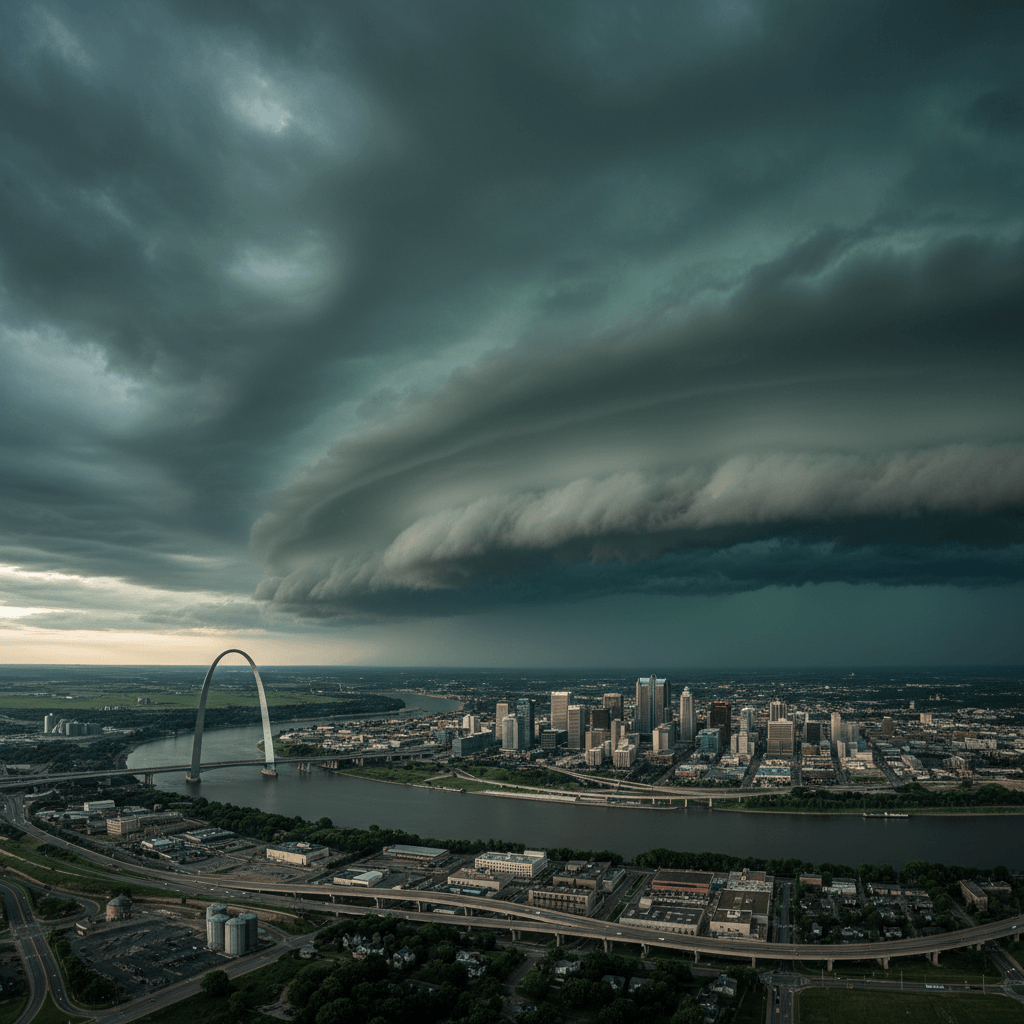
St. Louis sits at a meteorological crossroads where warm, moisture-heavy air pushing north from the Gulf of Mexico regularly collides with cold, dry air masses descending from the Plains. That collision zone produces exactly the kind of violent convective storms FEMA keeps documenting. The question for St. Louis households isn’t whether another event is coming, the FEMA record answers that, but whether you’ll be ready when it does.
📊 MO: Federally Declared Disasters (2016–2026)
20 major disaster declarations were issued in this period, according to FEMA records.
| Disaster type | Declarations |
|---|---|
| Severe Storm | 13 |
| Flood | 5 |
| Biological | 2 |
Most recent declarations
| Date | Type | Event |
|---|---|---|
| 2026-06-30 | Severe Storm | Severe Storms, Tornadoes, And Flooding |
| 2025-07-22 | Severe Storm | Severe Storms And Flooding |
| 2025-06-09 | Severe Storm | Severe Storms, Straight-Line Winds, Tornadoes, And Flooding |
| 2025-06-09 | Severe Storm | Severe Storms, Straight-Line Winds, Tornadoes, And Flooding |
| 2025-05-21 | Severe Storm | Severe Storms, Straight-Line Winds, Tornadoes, And Wildfires |
| 2025-05-21 | Severe Storm | Severe Storms, Straight-Line Winds, Tornadoes, And Flooding |
Source: FEMA OpenFEMA Disaster Declarations · retrieved 2026-07-20 by US Risk Radar.
Key Takeaways
- Missouri’s FEMA disaster history since 2016 is dominated by severe storms, 13 out of 20 declarations.
- St. Louis is in a prime collision zone for the atmospheric conditions that produce tornadoes and straight-line winds.
- Straight-line wind damage is frequently misidentified as tornado damage, your prep plan needs to cover both.
- Flooding follows almost every major storm event in the FEMA record; your kit and your escape route need to account for it.
- A safe room, a communication plan, and 72 hours of supplies are the three things that matter most.
Tornadoes Are Only Part of What Missouri’s Storm Season Delivers
Every recent FEMA declaration for Missouri lists tornadoes alongside straight-line winds and flooding. That matters for how you prepare. Straight-line winds, produced by downbursts inside severe thunderstorms, can reach 100 mph or higher and cause structural damage that looks indistinguishable from a weak tornado. Unlike a tornado, there’s no rotating column to track on radar; the damage can be widespread and arrive with very little warning time.
The National Weather Service office in St. Louis (weather.gov/lsx) issues Severe Thunderstorm Warnings specifically for these events. Most people treat a thunderstorm warning as a lesser alert than a tornado warning and stay where they are. That’s a mistake. A severe thunderstorm warning with 80+ mph winds deserves the same shelter response as a tornado warning: interior room, lowest floor, away from windows.
The flooding piece is also not optional to plan around. Five of Missouri’s 20 federal disaster declarations since 2016 were flood events, and nearly every severe storm declaration in the FEMA record includes flooding in the event title. St. Louis is bisected by major waterways, the Mississippi and Missouri rivers, and urban drainage can overwhelm quickly after a fast-moving storm drops two or more inches in an hour. Know your address’s flood zone status through FEMA’s flood map service and have a route out of your neighborhood that doesn’t cross low-lying underpasses or bridge approaches.
Your Safe Room Setup for a City Built Without Many Basements
Older St. Louis city homes often have full basements; many suburban and newer construction homes do not. If your home has a basement, that’s your primary shelter, clear a path to it now, before a watch is issued. Keep a pair of shoes, a flashlight, and a battery-powered or hand-crank NOAA weather radio down there. When sirens go off is not the time to find those things.
If you have no basement, the calculus changes. Pick the smallest interior room on the lowest floor, a bathroom, a closet, a hallway, with no exterior walls and no windows. A bathtub can provide marginal additional protection from debris if you pull a mattress over yourself. It’s not ideal, but physics matters: mass and interior walls between you and flying debris are what keep you alive.
Mobile homes are not survivable shelters in a tornado or a severe straight-line wind event. If you live in one, identify the nearest permanent structure with a basement or a community shelter before storm season begins. When a watch is issued, not a warning, a watch, that is when you leave.
📦 Recommended: Easy Cellar
Building a secure, underground space is the gold standard for tornado safety in the Midwest. The Easy Cellar guide provides actionable plans for creating a protected shelter on your property.
What to Have Ready Before the Next Severe Storm Warning Hits
Based on the pattern in Missouri’s FEMA record, fast-moving storm systems that knock out power, flood roads, and make neighborhoods impassable for 24 to 72 hours, your supply baseline should cover at least three days of full self-sufficiency. That means no assumption of a working grocery store, a navigable road, or a functional cell signal.
- Battery-powered or hand-crank NOAA Weather Radio, this is your alert system when your phone loses signal or power
- One gallon of water per person per day for at least three days
- Non-perishable food: canned goods, protein bars, peanut butter, things that don’t require cooking
- Flashlight with extra batteries and a backup power bank for your phone
- First aid kit with trauma supplies including gauze and a tourniquet
- Whistle to signal for help if you’re trapped under debris
- Multi-tool or adjustable wrench for utility shut-off
- N95 masks, useful after structural damage kicks up particulates
- Local paper maps and a written emergency contact list (phones die)
- Seven-day supply of prescription medications, refill proactively before storm season
- Sturdy closed-toe shoes and work gloves for moving through debris
- Cash in small bills, card readers don’t work without power
Keep this kit in two places: your basement shelter area and a bag you can grab in 90 seconds if you’re evacuating.
Communication: The Part Most Families Skip Until It’s Too Late
When a fast-moving storm system hits St. Louis, local cell networks saturate almost immediately. Calls drop. Texts queue. The families who stay coordinated are the ones who made a plan on a Tuesday afternoon, not during the storm itself.
Designate a single out-of-state contact that every household member knows how to reach, someone in a different region whose local network won’t be congested by the same event. Text consumes less bandwidth than calls. Agree in advance on where each family member shelters if a warning is issued during the school or work day. Write it down. Put it somewhere physical.
Monitor the NWS St. Louis office and set Wireless Emergency Alerts to enabled on every phone in your household. The St. Louis City Office of Emergency Management also maintains updated guidance during active events.
Frequently Asked Questions
Missouri’s FEMA declarations keep listing both tornadoes and straight-line winds, do I need to prepare differently for each?
Your shelter response is the same: interior room, lowest floor, away from exterior walls and windows. The difference matters more for aftermath. Straight-line wind damage tends to be linear and widespread rather than a narrow path, which can mean larger power outages and more road debris across a broader area. Build your 72-hour kit around the assumption that your neighborhood may be inaccessible either way.
Flooding appears in almost every Missouri severe storm declaration, should I be worried about it even if I don’t live near a river?
Yes. Urban flash flooding from overwhelmed storm drains can happen anywhere in the metro after a fast, heavy rain event, which is exactly what accompanies the storm systems in Missouri’s FEMA record. Check your flood zone at fema.gov/flood-maps, and never drive through water covering a road, six inches of moving water can knock a person down; two feet can carry a vehicle.
Missouri had a FEMA severe storm declaration in January 2025, does that mean St. Louis needs to be prepared year-round, not just in spring?
That January declaration is a useful reminder that Missouri’s severe weather window is not limited to April and May. Warm, moist air intrusions can trigger significant storms in late fall and winter, and the NWS St. Louis office has issued tornado warnings in every calendar month on record. Spring remains the peak, but “storm season” in Missouri is effectively 12 months long. Your kit should stay stocked and your plan should stay current all year.
Local Resources
- National Weather Service (NWS) St. Louis
- St. Louis City Emergency Management
- FEMA Disaster Preparedness Hub
Get real disaster prep, decoded from FEMA, NOAA & USGS.
One short email when something actually matters for your zip code. No spam, ever.