
Since January 2016, Georgia has received 16 federally declared disaster declarations, and not one of them was for a tornado. Six were hurricanes. Three were tropical storms. Hurricane Helene alone generated two separate federal declarations in the same week of September 2024. That context matters enormously for anyone in Atlanta trying to build a real emergency plan, not just a tornado drill checklist.
Your county's real disaster history, what to do first, and what to keep at home. Free, and it shows up right here.
🔒 We never sell your email. Unsubscribe in one click.
That doesn’t mean tornadoes aren’t a threat here, they absolutely are, and the NWS Peachtree City office covers a region with documented tornado history. But if you live in Fulton County or the surrounding metro and you’re only prepped for a twister, you’ve planned for the least likely item on Georgia’s actual federal disaster ledger.
📊 GA Federally Declared Disasters (2016–2026)
16 major disaster declarations were issued for GA in this period, according to FEMA records.
| Disaster type | Declarations |
|---|---|
| Hurricane | 6 |
| Tropical Storm | 3 |
| Fire | 2 |
| Severe Storm | 2 |
| Biological | 2 |
| Winter Storm | 1 |
Most recent declarations
| Date | Type | Event |
|---|---|---|
| 2026-04-22 | Fire | Highway 82 Fire |
| 2026-04-21 | Fire | Pineland Road Fire |
| 2026-01-24 | Winter Storm | Severe Winter Storm |
| 2024-09-30 | Hurricane | Hurricane Helene |
| 2024-09-26 | Tropical Storm | Hurricane Helene |
| 2024-09-24 | Tropical Storm | Tropical Storm Debby |
Source: FEMA OpenFEMA Disaster Declarations · retrieved 2026-07-19 by US Risk Radar.
Atlanta Sits in Georgia’s Hurricane Shadow
Atlanta is roughly 250 miles from the Gulf Coast and about 300 from the Atlantic, far enough that residents don’t buy hurricane shutters, close enough that the remnants of major storms arrive with dangerous force. Hurricane Helene in late September 2024 is the clearest recent example: what made landfall in Florida as a Category 4 storm drove catastrophic flooding and wind damage deep into inland Georgia, triggering a federal Hurricane declaration on September 30 and a separate Tropical Storm declaration four days earlier.
Tropical Storm Debby hit the same way in August 2024, prompting yet another declaration. That’s three federal storm events in roughly six weeks.
What this means practically for Atlanta households:
- Inland flooding is your primary hurricane threat, not storm surge. Storm drains in Atlanta’s hilly terrain can overwhelm quickly. Know whether your address sits in or near a FEMA-mapped flood zone at msc.fema.gov.
- Power outages last days, not hours. Helene knocked out electricity for hundreds of thousands of Georgians. A generator, or at minimum a battery bank capable of keeping phones and medical devices running for 72 hours, is not optional.
- Track storms earlier than you think you need to. By the time a Gulf system gets a cone discussion that includes Georgia, you may have 48–72 hours, but roads out of Atlanta clog fast. Check weather.gov/ffc/ (NWS Peachtree City) when a named system enters the Gulf or approaches the Carolinas coast.
Tornado Planning for Atlanta. What’s Actually Different Here
Atlanta tornadoes tend to arrive embedded in fast-moving squall lines rather than the classic supercell systems common in Tornado Alley. That means less visual warning, shorter lead times, and a higher likelihood the storm hits at night. The March 2008 tornado that struck downtown during an SEC tournament game remains the benchmark local example. EF2 damage in an urban core where nobody expected it.
Your safe room setup matters more than knowing general tornado facts:
- Pick the room now, before spring. Interior room, lowest floor, no windows. A bathroom with plumbing walls or a central hallway closet. If you have a basement, that’s your answer, most Atlanta-area homes don’t.
- Sign up for Fulton County’s emergency notification system at fultoncountyga.gov. Wireless Emergency Alerts on your phone cover warnings but county notifications can give you earlier situational context.
- Keep a battery-powered NOAA weather radio with SAME encoding set to your county’s code. When your phone is charging in another room at 2 a.m., the radio wakes you up.
- Garage doors are the weak point in most Atlanta homes. Standard residential garage doors are not rated for the wind speeds an EF1 or EF2 produces. If your safe interior space requires passing through the garage, know that route and time it before you need it.
- Mobile homes are not shelters. If you or anyone in your family lives in a mobile home in the metro area, locate the nearest permanent structure or designated public shelter and pre-plan the route. Do this when a watch is issued, not when a warning sounds.
Georgia’s Wildfire Problem Is Closer Than Most Atlantans Realize
Two of Georgia’s 16 federal declarations since 2016 were for fire, and both came in April 2026: the Highway 82 Fire and the Pineland Road Fire, declared on consecutive days. Wildland-urban interface fires in South Georgia can generate smoke plumes that degrade air quality in Atlanta within hours.
This isn’t a prepare-your-go-bag-and-evacuate scenario for most Atlanta residents, it’s an air quality scenario. Keep N95 masks in your emergency kit (they serve double duty for smoke and other airborne hazards). If you have household members with asthma, COPD, or heart conditions, have a clear indoor air plan: sealed windows, HVAC filters rated MERV-13 or higher, and a portable air purifier with a HEPA filter.
Monitor airnow.gov during any active Georgia wildfire event. An AQI above 150 is unhealthy for the general population, not just sensitive groups.
The Winter Storm You Probably Didn’t Fully Plan For
Georgia’s January 2026 Severe Winter Storm federal declaration was a reminder that Atlanta’s ice-storm vulnerability isn’t a quirk, it’s a structural feature of the region’s geography and infrastructure. The city’s mild baseline temperatures mean roads ice over fast and the equipment to treat them is limited compared to northern states.
The practical gap most Atlanta households have: food and water for more than 24 hours. A 72-hour supply of non-perishables, a manual can opener, and enough water stored (one gallon per person per day) to cover three days is the FEMA baseline, and it covers you whether the disruption is ice, a hurricane remnant, or a tornado aftermath.
Build One Kit That Covers All of It
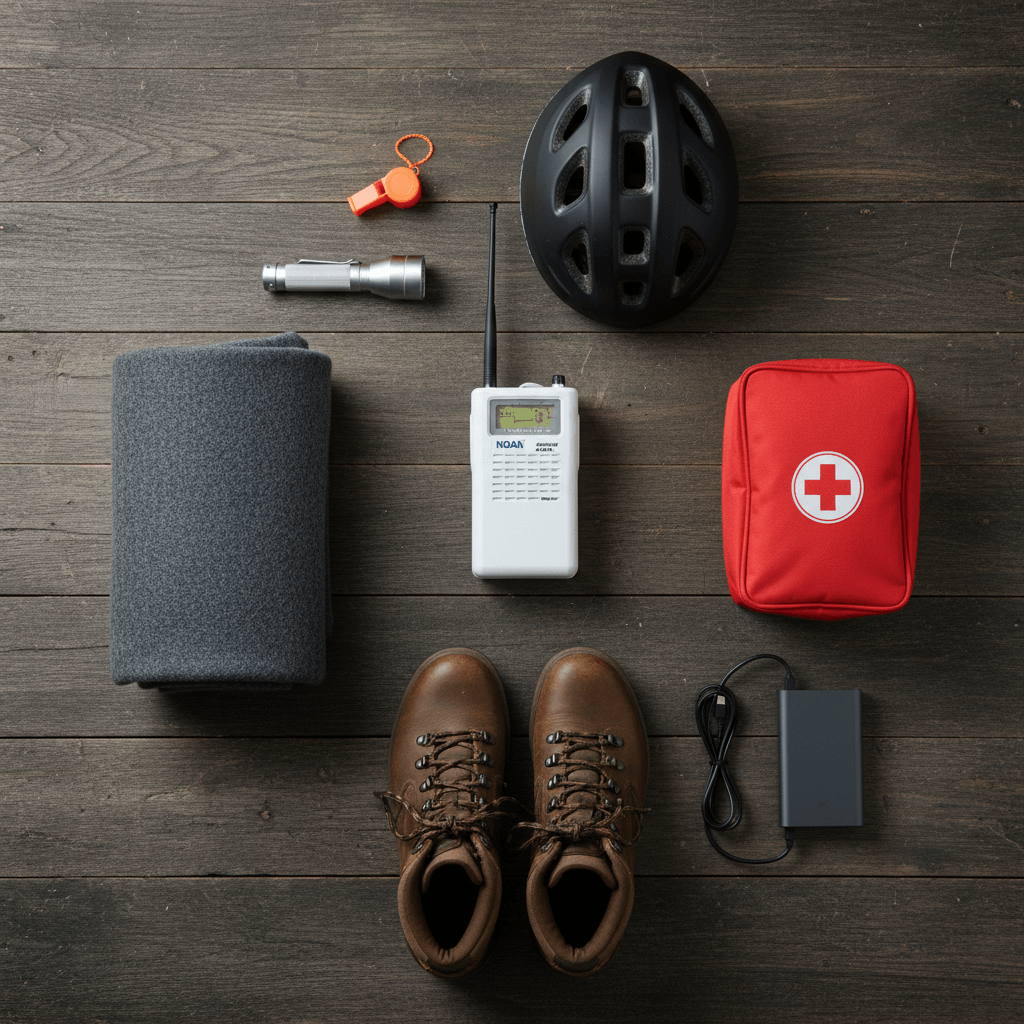
Georgia’s disaster profile, hurricanes, tropical storms, winter ice, wildfires, and tornadoes, is broad enough that a single well-stocked emergency kit serves every scenario better than event-specific prep. The core:
- Water: one gallon per person per day, minimum three days (seven days preferred)
- Food: non-perishable items your household will actually eat, rotating stock
- Battery or hand-crank NOAA weather radio
- Flashlights and extra batteries (or a hand-crank/solar option)
- First-aid kit with any prescription medications, 30-day buffer minimum
- N95 masks (wildfire smoke, post-storm debris)
- Phone charger bank, fully charged
- Copies of key documents in a waterproof bag: insurance cards, IDs, FEMA flood policy if applicable
- Cash in small bills. ATMs go down when power does
- Pet supplies if applicable: food, carrier, vaccination records, leash
Keep this kit accessible from your safe room. After a tornado warning, you’re not going to the garage to retrieve it.
Know Your Local Contacts Before You Need Them
- Fulton County Emergency Management Agency: fultoncountyga.gov
- Georgia Emergency Management and Homeland Security Agency (GEMA/HS): gema.georgia.gov
- NWS Peachtree City (Atlanta forecast office): weather.gov/ffc/
Frequently Asked Questions
Georgia had six hurricane federal declarations since 2016, why does Atlanta need to care about hurricanes?
Because hurricane remnants don’t lose their rainfall when they lose their eyewall. When Helene moved inland in September 2024, it produced catastrophic flooding well into the Carolinas and drove federal disaster declarations across Georgia. Atlanta’s rivers and drainage systems aren’t built for the rainfall totals a dying major hurricane can dump in 12 hours. Inland flooding, not wind, is the primary hurricane threat for metro Atlanta residents.
What’s the actual tornado warning lead time I can expect in Atlanta?
The national average NWS tornado warning lead time is roughly 13 minutes, but squall-line tornadoes, the most common Atlanta type, often arrive with less. Your goal is to be in your safe room when the warning is issued, not when it sounds. That means monitoring the weather before severe weather days, not reacting to the warning tone. Check weather.gov/ffc/ any morning when a squall line is forecast.
Should I get flood insurance even if I’m not in a high-risk FEMA flood zone?
Georgia’s recent federal declarations, particularly those tied to Helene and Debby in 2024, affected properties that weren’t in designated Special Flood Hazard Areas. FEMA data consistently shows that roughly 20% of flood insurance claims come from outside high-risk zones. Flood damage is not covered by standard homeowners or renters insurance. Check the National Flood Insurance Program at fema.gov/flood-insurance for current policy options.
For more on related hazards, see our tornado preparedness, flood preparedness and thunderstorm preparedness guides.
Disclaimer: This guide is for informational purposes only and does not constitute professional engineering or emergency management advice. Always follow instructions from local authorities during a declared emergency. For life-threatening situations, call 911 immediately.
Get real disaster prep, decoded from FEMA, NOAA & USGS.
One short email when something actually matters for your zip code. No spam, ever.